
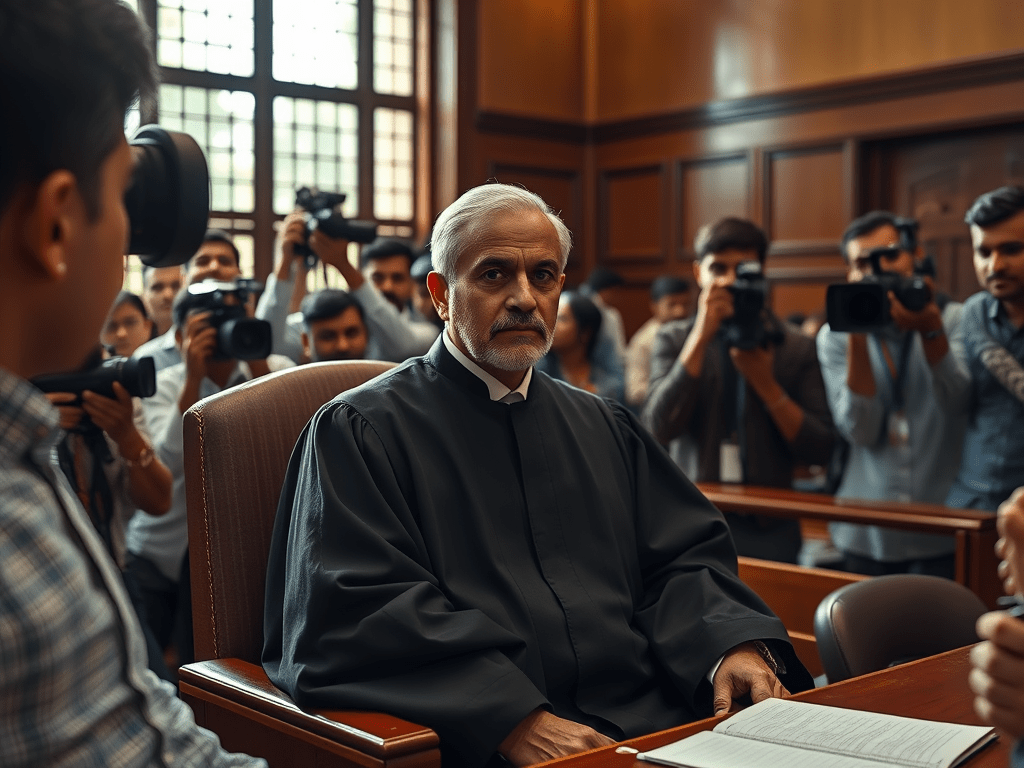
When the country was reeling under the most severe spell of COVID-19, the reportage on the oral observations made by the Madras High Court, reprimanding the Election Commission of India (ECI), stirred debate on the ethical sanctum sanctorum of media, when it comes to reporting oral remarks by the judges, not forming a part of their judgments.

Madras High Court, while entertaining the Writ Petition filed by M.R. Vijaya Bhaskar, the AIADMK candidate for Karur Legislative Assembly Constituency, seeking directions for observance of Covid-19 protocol at the place of counting votes, made scathing remarks on ECI. This dressing-down came on the heels of the poor protocol management in the polling stations and the flouting of COVID-19 measures in political rallies and campaigns.

The Court lambasted the ECI, calling it “the institution that is singularly responsible for the second wave of COVID-19” and the one that “should be put up for murder charges."
This commentary was in every media report and social media platform, bringing ECI to the dock.
The ECI ultimately approached the Supreme Court, seeking a restraining order against the media from reporting on Madras High Court remarks, which are not only disparaging but also undermine the dignity of a constitutional body.
The Apex Court, while emphasizing the courtrooms as a public place, refused to entertain their plea. The court said such honest and full reportage gives readers a gateway into whether judges are genuinely applying their minds in crisis-solving.
Justice Dr. Dhananjaya Yeshwant Chandrachud speaking for the apex court in The Chief Election Commissioner of India v M.R Vijayabhaskar & Ors. (AIR 2021 SUPREME COURT 2238), affirmed the Court to be the staunch proponent of the freedom of the media to report court proceedings, fostering judicial accountability.
The Court, however, cautioned the judges against using off-the-cuff remarks in open Court, which can be prone to misinterpretation. It said language, both on the Bench and in judgments, must meet the standards of judicial propriety.
In another case involving BJP Spokesperson Nupur Sharma, the court’s remarks caused a hue and cry all over the internet, with X ( formerly Twitter) divided over the necessity for judges to comment.
The Bench of Justices Surya Kant and JB Pardiwala made oral remarks, calling her “single-handedly responsible for fanning the flames across India” for her controversial remark on Prophet Mohammad (PBUH), which stirred riots. The bench advised her to apologize to the whole nation.
The quick-to-comment citizenry on the Internet and polarized ideological people often fail to acknowledge the fact that judges’ social commentary highlights the current moral, political, and economic status of society. Judges deal with the hearing of the cases first-hand. Their oral commentaries do not form part of their judgments, but underscore the substance of the case and, often, represent a reflection of socio-political scenario of society. Thus, it falls on the shoulders of the media to report on the oral exchanges between the bar and the bench during legal hearings.
In most such controversies, the question that arises is to what extent there is freedom of speech and expression (Article 19) and the right to know and receive information (Article 21).
What transpires within the walls of democratic institutions would hardly be known had there been no media. It is the media that Victorian writer Thomas Carlyledubbed the fourth estate of the realm. It rests on the shoulders of the media to simplify the legal discourse for the last man standing, sine qua non, reporting what is said and meant, refraining from sensationalizing court reports in pursuit of clicks.
Article 19 (1) (a) enshrines freedom of speech and expression subject to reasonable restrictions given in Article 19 (2). The constitution bench in Express Newspaper (P) Limited vs Union of India (1959 SCR 12)held that freedom of the press is implicitly couched in the words of Article 19(1) (a), and voiced:
“As with all freedoms, press freedom means freedom from and freedom for. A free press is free from compulsions from whatever source, governmental or social, external or internal. From compulsions, not from pressures; for no press can be free from pressures except in a moribund society empty of contending forces and beliefs.”
It is pertinently true that the media is considered an educator, which is essential for creating an informed citizenry. Any attempt to stifle, smother, or gag this right, notwithstanding Article 19 (2), would sound a death knell to democracy, ushering in autocracy or dictatorship. Therein lies the necessity and freedom of the media to comment on and write about proceedings. The “Madrid Principles on the Relationship between the Media and Judicial Independence” recognizes this element, which can also be traceable within Indian jurisprudence.
The European Court On Human Rights, in the case of Riepan v. Austria, no. 35115/97, ECHR 2000-XII, held that a trial must comply with the requirement of publicity. The applicant in this case did not have a public hearing, as the trial happened in prison.
The Court observed,
“The holding of a trial outside a regular courtroom, in particular in a place like a prison, to which the general public in principle has no access, presents a serious obstacle to its public character. In such a case, the State is under an obligation to take compensatory measures to ensure that the public and the media are duly informed about the place of the hearing and are granted effective access.”
An open court proceeding guarantees that the judicial process is subject to public scrutiny. It emboldens transparency and accountability, essential for establishing the public’s faith.
An open court ensures that judges maintain the law and legal probity. Journalists, on the other hand, in courtrooms bridge the looming gap between the citizens and their courts, bolstering judicial awareness. Such reportage opens the sealed gates of knowledge for a common man who believes the road to the courtrooms can only be covered by the rich and powerful.
It is highly likely that in the absence of such reporting, citizens would remain uninformed about the happenings in courts, and the courtrooms would remain a mystery.
The press creates informed and aware citizens. A person of reasonable intellect would grasp how oral observations of judges are not a part of judgments. Curtailing journalists’ right to report what is happening in the courts is deleterious to the foundational principles of democracy — freedom, accountability, equality, and inclusivity.
 The Legal Palate
Leave a comment